SEO in 2026: What Actually Moves the Needle (And What's Just Noise)
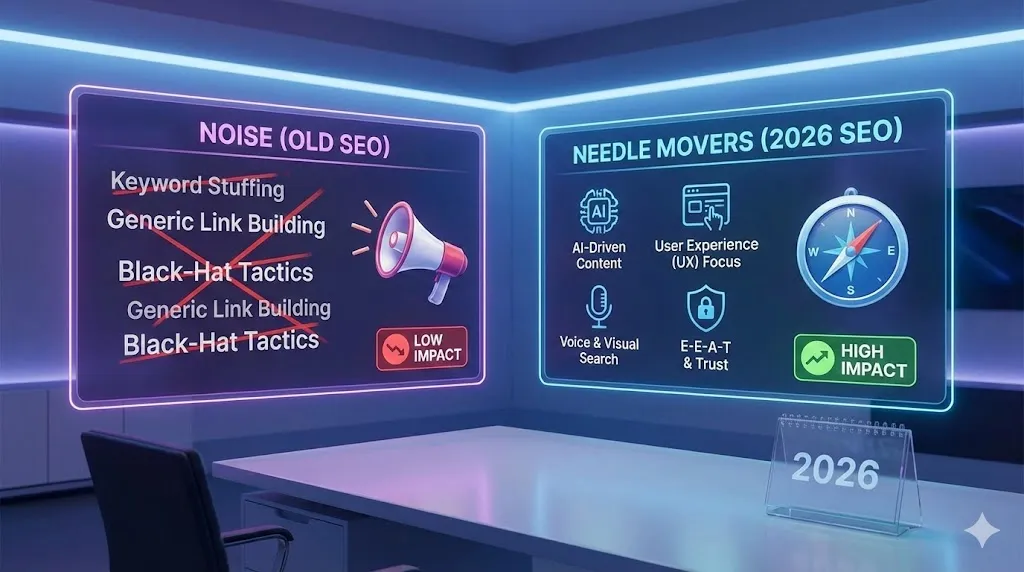
Search has changed more in the past 18 months than in the previous decade.
Google’s AI Overviews now appear on roughly 15-20% of all searches. When they do, organic click-through rates drop by an average of 61%. Zero-click searches have surged to 60-75% of all queries. Some publishers have reported traffic losses as high as 89% on affected keywords.
If you’re still running the same SEO playbook from 2023, you’re playing a game that no longer exists.
But here’s what most people miss: this isn’t the death of SEO. It’s a fundamental shift in what SEO success looks like. The goal is no longer just ranking — it’s being cited, being trusted, and being the source AI systems pull from when generating answers.
This post breaks down what actually works in 2026, how Google’s algorithm evaluates content now, and what you can safely ignore. Whether you’re running a local service business, an e-commerce store, or building your personal brand online, these fundamentals apply.
The New Reality: Ranking vs. Being Cited
Before diving into tactics, you need to understand what’s changed at a fundamental level.
Google launched AI Overviews to all U.S. users in May 2024. By late 2025, AI Mode followed — a full conversational search experience powered by Gemini that can run up to 16 searches simultaneously to answer a single query. Neither feature shows the traditional “10 blue links.” You either get cited inside the AI response, or you don’t appear at all.
The January 2026 Google updates reinforced this direction. The algorithm continues rewarding content that demonstrates genuine expertise, provides real value to users, and maintains strong technical foundations. Mass-produced AI content without human oversight is losing visibility. Thin, templated pages are getting filtered out.
Here’s the critical insight: research shows that 92% of successful AI Overview citations come from domains already ranking in the top 10 organic positions. Traditional SEO still matters — it’s the foundation that makes AI visibility possible. But ranking alone is no longer enough. You need content that AI systems recognize as trustworthy and worth citing.
Think of it this way: traditional SEO gets you into the room. E-E-A-T signals and citation-worthy content determine whether you get to speak.
Understanding E-E-A-T: Google’s Trust Framework
Before we dive into specific ranking factors, you need to understand the framework Google uses to evaluate whether your content deserves to rank. It’s called E-E-A-T, and in 2026, it’s more important than ever.
E-E-A-T stands for Experience, Expertise, Authoritativeness, and Trustworthiness. Google introduced this framework in its Search Quality Rater Guidelines — the instructions human evaluators use to assess search results. While E-E-A-T isn’t a direct ranking factor you can measure, Google’s algorithms are trained to detect signals that indicate high E-E-A-T.
Experience means you’ve actually done the thing you’re writing about. You’ve used the product, visited the place, or worked in the field. Content that reflects personal, hands-on involvement signals authenticity that generic content can’t replicate.
Expertise is about demonstrable knowledge. Do you understand the subject deeply? Can you explain complex topics clearly and accurately? Expertise shows up through depth, precision, and technical accuracy.
Authoritativeness comes from external recognition. Other credible sources cite you, link to you, or mention you as a go-to source in your field. It’s not just about what you say about yourself — it’s what others say about you.
Trustworthiness is the foundation everything else sits on. Google’s guidelines explicitly state that “Trust is the most important member of the E-E-A-T family because untrustworthy pages have low E-E-A-T no matter how Experienced, Expert, or Authoritative they may seem.”
These four elements aren’t standalone — they overlap and reinforce each other. Strong expertise naturally boosts your authority. High trustworthiness makes your experience more convincing. It’s a virtuous cycle when done right, and a downward spiral when neglected.
Why This Matters More in 2026
AI-generated content has flooded the internet. Anyone can produce passable content in minutes. Google’s response has been to raise the bar for what earns visibility, placing more weight on signals that AI content typically lacks: genuine experience, verifiable expertise, and earned authority.
AI systems like ChatGPT, Perplexity, and Google’s AI Mode are built to identify reliable patterns. They look for verified sources and credentials, factual writing based on experience, consistency between claims and evidence, and how often your content or brand is cited elsewhere.
When your content gets summarized in AI search results, the system evaluates who’s speaking, how credible they are, and whether their information matches the web’s consensus. E-E-A-T isn’t just a content framework anymore — it’s the language AI uses to decide who to trust.
Factor #1: Content Quality Has a Higher Bar
The phrase circulating among SEO professionals in 2026 is “average is the new bad.”
Generative AI has made it trivially easy to produce decent content. Anyone can spin up a passable blog post in minutes. The result is that Google has raised the threshold for what earns visibility. Content that would have ranked three years ago now gets filtered as undifferentiated noise.
How Google Evaluates Content Now
Google’s systems assess whether content was created primarily for users or primarily to manipulate rankings. The algorithm looks for signals of genuine expertise — original insights, first-hand experience, depth that generic AI content can’t replicate.
The September 2026 core update specifically targeted sites with high volumes of keyword-stuffed, low-value content. Sites that demonstrated clear expertise and provided comprehensive, well-researched information saw ranking improvements. Sites relying on templated or superficial content saw declines.
Google hasn’t penalized AI-generated content outright. But content lacking originality, accuracy, or real insight struggles to perform. High-ranking pages demonstrate editorial oversight, expertise, and alignment with what the searcher actually needs.
The Experience Differentiator
In 2026, AI algorithms give more weight to lived experience than to polished, robotic writing. Content that demonstrates you’ve actually done the thing — tested the product, implemented the strategy, made the mistakes — ranks higher than content that simply explains concepts.
This is where small businesses and independent creators have an advantage. A local contractor writing about common renovation mistakes they’ve encountered has experience a content farm can’t replicate. A small e-commerce brand sharing behind-the-scenes testing photos has authenticity that generic product descriptions lack.
Practical Steps to Improve Content Quality
Your content needs to answer the question better than anything else available. That means original research, personal experience, expert perspective, or unique data — something a competitor can’t replicate by running the same prompt through ChatGPT.
Include specific examples from your own work. “We tested this approach with 15 clients over six months” is more compelling than generic advice. Add original images, screenshots of processes, or photos that prove you’ve done the work.
Structure content so AI systems can easily extract and cite key information. Use clear headings, direct answers near the top, and factual statements that can stand alone. If your content is “citation-worthy,” it has a better chance of appearing in AI Overviews.
First-page results for competitive queries average around 1,400 words. Not because length itself ranks, but because comprehensive treatment of a topic tends to satisfy searchers more completely than surface-level overviews. Go deep on topics you understand well rather than wide across topics you don’t.
Factor #2: User Engagement and Search Intent
User engagement has become the fifth most important factor in Google’s algorithm, now accounting for roughly 12% of ranking weight. This percentage has increased each of the last three years.
How It Works
Google tracks how users interact with search results. When someone clicks your listing and stays engaged, that’s a positive signal. When they click, immediately bounce back, and choose a different result (called “pogo-sticking”), that tells Google your page didn’t satisfy the query.
Metrics that matter include click-through rate from search results, dwell time on page, scroll depth, and whether users engage with your content or leave immediately.
The January 2026 updates showed Google placing even more weight on these behavior signals. Content that keeps users engaged ranks better. Content that fails to deliver on its promise gets pushed down.
Matching Search Intent
Google’s AI systems (BERT, MUM, and the models powering AI Mode) understand context and meaning — not just keywords. When someone searches “best running shoes for flat feet,” Google knows they want recommendations, not a history of podiatry.
There are four main types of search intent:
Informational — The person wants to learn something (“how to fix a leaky faucet”). They need explanation, steps, or education.
Navigational — The person wants a specific website (“Amazon login”). They already know where they want to go.
Commercial — The person is researching before buying (“best CRM software 2026”). They want comparisons, reviews, and options.
Transactional — The person is ready to act (“buy Nike Air Max size 10”). They want to complete a purchase or take immediate action.
Your content must match the intent behind your target keywords. If everyone ranking on page one has comparison articles, Google has determined that’s what searchers want. Publishing a product page for that keyword won’t work — it doesn’t match what users expect.
Practical Steps to Improve Engagement
Before creating content, search your target keyword and study what ranks. What format appears? What questions get answered? What depth is expected? Your content should meet or exceed that standard.
Write compelling title tags and meta descriptions that accurately represent your content. Clickbait titles that don’t match the actual page content will hurt you — users bounce, and Google notices.
Put valuable information up front. If someone has to scroll through paragraphs of filler before reaching the answer, they’ll leave. Structure for quick value delivery, then go deeper for users who want more.
Format for easy reading. Use short paragraphs, clear subheadings, and visual breaks. Walls of text cause bounces, especially on mobile where most searches happen.
Factor #3: Freshness and Regular Updates
Freshness has vaulted from a minor factor to the 6th biggest ranking signal, now accounting for roughly 6% of Google’s algorithm.
How It Works
Google’s systems track when content was last updated. Data shows that pages updated at least once per year gain an average of 4.6 positions in search results compared to pages that haven’t been touched.
This matters more for some topics than others. A page about “how photosynthesis works” doesn’t need monthly updates. But a page about “best project management software” or “current tax brackets” needs recent information to be useful.
The algorithm also considers publication patterns. Sites that consistently publish helpful content get faster indexing and tend to rank better over time compared to sites that publish sporadically.
Why Freshness Matters More Now
In the age of AI Overviews, Google favors content with current information. AI systems pulling from your content want accurate, up-to-date facts. Outdated statistics, old examples, or references to past years signal that your content may not be reliable.
The shift is clear: content freshness is no longer optional for topics that change over time. If your competitors update their content and you don’t, they’ll outrank you even if your original content was better.
Practical Steps to Improve Freshness
Audit your existing content quarterly. Identify pages that drive traffic but haven’t been updated in over a year. Update statistics, refresh examples, add new developments, and change the publication date when you’ve made meaningful improvements.
Don’t just change a few words to game the timestamp. Google’s systems can detect superficial updates. Make genuine improvements that add value — new sections, updated data, improved explanations.
Build a sustainable publishing cadence. Consistent output of quality content signals to Google that your site is actively maintained and authoritative in your space. For most small businesses, one substantial piece of content per week is better than five thin posts.
Create a content calendar that includes both new content and updates to existing pages. The combination of fresh topics and refreshed evergreen content keeps your entire site performing.
Factor #4: Backlinks and Authority
Links from other websites remain a core ranking factor. Domain authority, external links to specific pages, and internal linking together account for a significant portion of how Google evaluates trustworthiness.
How It Works
When a reputable site links to your content, it signals that your information is worth referencing. Google evaluates both the quantity and quality of these links. One link from a major publication or respected industry site carries more weight than dozens of links from random, low-quality sites.
Research shows 86% overlap at the domain level between sites ranking in traditional search results and those appearing in AI Overviews. The sites Google trusts for regular search are the same ones it trusts for AI-generated answers.
Link distribution diversity has also emerged as more important than previously understood. Having links from a variety of different domains and contexts signals broader authority compared to links concentrated from just a few sources.
The Authority Threshold
Here’s something most SEO guides don’t explain: there’s effectively an authority threshold for new sites. A new, low-authority blog — even with excellent content — might be filtered out before its content is ever deeply evaluated. Google’s systems look at site authority as a gatekeeping function before assessing individual page quality.
This means for new sites, the primary strategic goal isn’t just creating great content. It’s breaking through this authority threshold to become eligible to compete. That requires earning links, building brand recognition, and establishing credibility signals over time.
Practical Steps to Build Authority
Create content worth citing — original research, comprehensive guides, useful tools, or unique perspectives that others in your space would want to reference. Data-driven posts, original surveys, and in-depth case studies earn links naturally.
Guest posting on relevant industry sites builds both links and credibility. Contributing expert quotes to journalists through platforms like HARO (Help a Reporter Out) earns mentions and links from news sites.
Build relationships in your industry. Collaborate with others, participate in communities, and become known as a helpful resource. Links follow relationships more often than cold outreach.
Internal linking matters too. Link strategically between your own pages to help Google understand your site structure and distribute authority to important content. A strong internal linking structure helps new pages gain visibility faster.
Avoid buying links or participating in link schemes. Google’s algorithm has become sophisticated at detecting manipulation. Penalties can devastate your visibility and take months to recover from.
Factor #5: Technical SEO and Core Web Vitals
Content quality and authority drive rankings, but technical problems can prevent even excellent content from performing. The September 2026 update introduced more stringent requirements for Core Web Vitals and mobile usability, particularly affecting e-commerce and news sites with complex layouts.
How It Works
Core Web Vitals measure user experience through three metrics:
Largest Contentful Paint (LCP) — How fast the main content loads. Target: under 2.5 seconds. This measures when users can actually see your content, not just when the page starts loading.
Interaction to Next Paint (INP) — How quickly the page responds when users interact. Target: under 200 milliseconds. This replaced First Input Delay (FID) and measures responsiveness throughout the entire page session, not just the first click.
Cumulative Layout Shift (CLS) — How much the layout shifts unexpectedly while loading. Target: under 0.1. When elements jump around as the page loads, it frustrates users and causes misclicks.
Sites with poor Core Web Vitals struggle to rank competitively, especially for commercial queries where user experience directly impacts conversions. Mobile performance is the primary consideration — Google uses mobile-first indexing, meaning the mobile version of your site is what gets evaluated.
Beyond Speed: Technical Fundamentals
Technical SEO goes beyond page speed. The fundamentals include:
HTTPS Security — Now mandatory. Sites without SSL certificates face ranking penalties and browser warnings that scare away visitors.
Crawlability — Google’s bots need to access your pages. Broken links, blocked resources, or poor site architecture can prevent proper crawling.
Indexability — Just because Google can crawl a page doesn’t mean it will index it. Duplicate content, thin pages, noindex tags, and certain technical errors can prevent indexing.
Schema Markup — Structured data helps Google understand your content and enables rich results (star ratings, FAQ dropdowns, product information) that improve click-through rates.
Site Architecture — A logical structure with clear navigation helps both users and search engines. Important pages should be reachable within 3-4 clicks from your homepage.
Mobile Usability — Touch targets should be at least 44x44 pixels, text should be readable without zooming, and navigation should work smoothly on smaller screens.
Practical Steps to Improve Technical SEO
Test your site with Google’s PageSpeed Insights. It scores your Core Web Vitals and identifies exactly what’s causing problems.
Common speed fixes include compressing images, removing unnecessary code and plugins, using a content delivery network (CDN), enabling browser caching, and choosing quality hosting. For most sites, images are the biggest culprit — compress them and serve appropriately sized versions.
Use Google Search Console to monitor technical health. It shows crawl errors, indexing issues, Core Web Vitals problems, and manual penalties. Check it weekly and address issues promptly.
Implement schema markup for your content types. For local businesses, use LocalBusiness schema. For products, use Product schema. For articles, use Article schema with author information. While not a direct ranking factor, structured data improves how your content appears in search results.
Fix broken links, ensure important pages are indexable, and maintain logical site structure. Run a site audit with tools like Screaming Frog or Ahrefs at least quarterly.
Factor #6: Multi-Platform Presence and Brand Authority
This is the new reality of 2026: Google isn’t the only place your content needs to appear.
How It Works
AI systems like ChatGPT, Perplexity, and Google’s own AI Mode pull information from multiple sources when generating answers. These platforms process over a billion queries daily combined. Your visibility in AI-generated responses — what some call “AI Share of Voice” — depends on having an authoritative presence across platforms, not just on your website.
Google’s AI Overviews cite multiple sources and show increased preference for diverse content formats. Video content, Reddit discussions, and YouTube videos now appear more frequently in AI-generated summaries alongside traditional web pages.
In 2026, authority extends beyond backlinks. Brand presence, digital PR, consistent messaging, and how often your brand is searched directly all influence trust signals. Google notices when people look for you specifically, not just stumble upon you through generic searches.
The Multi-Platform Advantage
Successful content businesses in 2026 maintain presence across multiple platforms. This isn’t about being everywhere — it’s about being where your audience is and where AI systems look for authoritative sources.
For service businesses, this might mean YouTube tutorials, LinkedIn thought leadership, and active Google Business Profile management. For e-commerce, it could mean product videos, customer reviews across platforms, and presence in relevant Reddit communities.
The content doesn’t need to be unique everywhere. Repurpose your core expertise into formats appropriate for each platform. A comprehensive blog post can become a YouTube video, a LinkedIn article, an email newsletter, and multiple social posts.
Practical Steps to Build Multi-Platform Presence
Identify 2-3 platforms beyond your website where your target audience spends time. Focus on building genuine presence there rather than spreading thin across everything.
For YouTube: Create helpful video content around your expertise. How-to videos, explanations, and demonstrations perform well. YouTube content increasingly appears in AI summaries.
For LinkedIn: Share insights from your work, engage with industry conversations, and build connections with others in your field. LinkedIn profiles and posts are referenced in AI-generated answers.
Track your AI Share of Voice — how often your brand gets mentioned or cited in AI-generated responses compared to competitors. Test your target queries in ChatGPT, Perplexity, and Google AI Mode monthly to see where you appear and where you don’t.
Encourage and manage customer reviews. For local businesses especially, review quantity, quality, and recency are direct ranking signals that also influence AI citations. Make asking for reviews part of your standard customer follow-up process.
YMYL Topics: When the Stakes Are Higher
If your content covers topics that could significantly impact someone’s health, finances, safety, or life decisions, you’re in YMYL territory — “Your Money or Your Life.”
Google holds YMYL content to higher E-E-A-T standards because incorrect information in these areas can cause real harm. Medical advice, financial guidance, legal information, news about important events — all require stronger credibility signals than content about hobbies or entertainment.
What This Means Practically
For YMYL topics, expertise needs to be demonstrable. If you’re writing about medical topics, having a medical professional author or reviewer matters. If you’re covering financial advice, credentials and experience in finance signal trustworthiness.
This doesn’t mean only credentialed experts can create YMYL content. But it does mean you need to be transparent about your qualifications, cite reliable sources, and clearly distinguish between professional advice and personal experience.
If you run a business in a YMYL space (financial services, healthcare, legal, major purchases), invest more heavily in E-E-A-T signals. Author bios with credentials, citations to authoritative sources, clear disclaimers, and third-party verification all matter more for your content than for someone writing about gardening tips.
What You Can Safely Ignore
Not everything you read about SEO deserves attention. Here’s what falls into the noise category in 2026:
Exact-match keyword density — Google understands synonyms and context. Writing naturally matters more than hitting a specific keyword percentage. Keyword stuffing actively hurts you and makes content unpleasant to read.
Meta keywords tag — Google has ignored this for over a decade. Don’t waste time on it.
Buying cheap links — Link schemes might show short-term gains but carry serious penalty risk. Google’s systems are sophisticated at detecting manipulation. The recovery process from a link penalty takes months.
Obsessing over domain age — Newer sites with excellent content outrank older sites with mediocre content regularly. Age doesn’t grant authority; quality does.
Chasing every algorithm update — Google makes thousands of changes yearly. Most are minor. Focus on fundamentals, and you’ll weather updates without constant pivoting.
Publishing AI content without oversight — Google isn’t penalizing AI assistance, but mass-produced content without human expertise and editing performs poorly. AI is a tool to help you create better content faster, not a replacement for genuine expertise.
Social signals as direct ranking factors — Social media activity doesn’t directly boost rankings. Social can drive traffic and earn links, which help indirectly, but likes and shares aren’t ranking factors themselves.
Geotagging images — Testing has shown this doesn’t meaningfully affect rankings. Focus your time on things that matter.
Exact match domains — While “bestdogfood.com” might have slight advantages, it’s not worth building a business strategy around. Brand building matters more than keyword-stuffed domain names.
The 2026 SEO Playbook: Putting It All Together
If you’re a business owner without unlimited time for SEO, focus your energy on these five priorities in order:
First, create content that demonstrates genuine expertise and delivers real value. Ask yourself: would someone pay for this information? Would they share it with a colleague facing the same problem? If not, it’s probably not good enough to rank. Start with your areas of genuine expertise — the problems you solve daily, the questions you answer repeatedly, the mistakes you help clients avoid.
Second, update existing content regularly. Pages that stay fresh outperform stale ones by significant margins. Before creating new content, audit what you already have. Often, improving existing pages delivers faster results than starting from scratch. Set a quarterly reminder to review your top-performing pages and keep them current.
Third, make your site fast and mobile-friendly. Technical problems create a ceiling on what your content can achieve. Run PageSpeed Insights on your key pages, fix the major issues, and retest. For most sites, image compression and hosting quality are the biggest quick wins.
Fourth, earn authority through quality backlinks and multi-platform presence. Being cited by others signals trustworthiness to both Google and AI systems. Create content worth linking to, build relationships in your industry, and establish presence on platforms where your audience spends time.
Fifth, optimize for being cited, not just ranking. Structure content so AI systems can easily extract and reference your expertise. Clear answers to specific questions, factual statements that stand alone, and obvious expertise signals all increase your chances of being cited in AI Overviews.
The sites winning in 2026 aren’t gaming algorithms. They’re genuinely serving users better than competitors. When you create content that truly helps your audience, demonstrates real expertise, and delivers it on a site that works well technically, both rankings and AI citations follow.
Measuring Success in 2026
Traditional SEO metrics still matter, but they tell only part of the story. Here’s what to track:
Organic traffic and rankings — The classic metrics. Use Google Search Console for accurate data on impressions, clicks, and average position.
Click-through rate — If your impressions are high but clicks are low, your title tags and meta descriptions need work. If CTR dropped suddenly, check if AI Overviews are appearing for your keywords.
Engagement metrics — Time on page, pages per session, scroll depth. These indicate whether your content satisfies users once they arrive.
AI visibility — Manually test your target keywords in Google AI Mode, ChatGPT, and Perplexity monthly. Are you being cited? Are competitors? This is the new frontier of visibility measurement.
Branded search volume — Are more people searching for your brand name over time? This indicates growing awareness and authority.
Backlink profile — Track new links earned and overall domain authority trends. Quality matters more than quantity.
Conversions — Ultimately, traffic should drive business results. Track how organic visitors convert into leads, sales, or whatever action matters for your business.
The Bottom Line
SEO in 2026 is about being the best answer, not the best optimizer.
Google’s AI systems can detect surface-level content, recycled ideas, and manipulative tactics. The shortcuts that worked five years ago now hurt you. What works is genuine expertise, original perspective, and content that actually helps people.
Yes, traffic patterns have shifted. AI Overviews and zero-click searches mean some queries that used to drive clicks no longer do. But visibility opportunities are expanding for those who adapt. Being cited in AI responses builds authority even when the click doesn’t happen.
The fundamentals haven’t changed as much as the tactics. Understand what your audience needs. Create content that delivers it better than anyone else. Present it on a site that loads fast and works everywhere. Build genuine authority through expertise and relationships. Do that consistently, and the results follow — in traditional rankings, AI citations, and actual business outcomes.
The businesses that will thrive are those building real expertise and trust, not those chasing algorithm tricks. That’s always been true, but in 2026, Google’s systems are finally sophisticated enough to enforce it.
Need help adapting your SEO strategy for 2026? Gus Digital Solutions works with small businesses and e-commerce brands to build sustainable search visibility. We focus on strategies that work long-term, not quick fixes that disappear with the next algorithm update.
Reach out at gus@gusdigitalsolutions.com to discuss your goals.

Written by Gustavo Vasquez
Web developer and digital marketing consultant helping small businesses get online. 15+ years of tech experience, bilingual (English/Spanish).
Book a free consultationRelated Articles

Building iOS Apps with AI in 2026 — My Workflow with 8 Apps on the Store
How I use Claude Code, Codex, and 40+ AI API keys to build and ship iOS apps. Lessons from getting IronLog to 5 stars and almost getting rejected by Apple.
YouTube Shorts for Gym Content — My Strategy for 2026
How I create gym Shorts with Remotion, the posting schedule that works, and why single-exercise clips beat full workouts every time.
How to Get More Customers with Google Business Profile in 2026
Step-by-step guide to optimizing your Google Business Profile for more calls, visits, and customers. Proven GBP strategies that work in 2026.
Need help with your project?
Whether it's SEO, a new website, or fixing bugs - I can help.
Get in Touch